What Resources Was Used a Lot of African Art

Some African objects had been collected past Europeans for centuries, and there had been industries producing some types, peculiarly carvings in ivory, for European markets in some littoral regions. Between 1890 and 1918 the volume of objects profoundly increased every bit Western colonial expansion in Africa led to the removal of many pieces of sub-Saharan African fine art that were subsequently brought to Europe and displayed.[1] These objects entered the collections of natural history museums, fine art museums (both encyclopedic and specialist) and private collections in Europe and the United States. About 90% of Africa's cultural heritage is believed to exist located in Europe, according to French fine art historians.[2]
Initially mostly seen as illustrating the ethnology of different African cultures, in the 20th century appreciation of pieces equally artworks grew during the 20th century. Merely towards the stop of the century was "modern" African art in fine fine art genres accepted as pregnant.[iii]
19th century [edit]
Before the Berlin Conference of 1885, traders and explorers to Africa purchased or stole art as souvenirs and curios,[iv] spreading beyond the coast; ivory objects made forth African coasts had been collected for centuries, and many were fabricated by Africans for purchase past Europeans, mainly in areas reached by the Portuguese, such as the Afro-Portuguese ivories. The catamenia dominated by curio collecting, in which objects served as souvenirs, was followed by a period of bays collecting in which big collections of artifacts (mostly weapons), and animal skins, horns, and tusks from hunting expeditions were formed.[iv]
Starting in the 1870s, thousands of African sculptures arrived in Europe in the backwash of colonial conquest and exploratory expeditions. They were placed on view in museums such equally the Musée d'Ethnographie du Trocadéro, founded in 1878 in Paris, and its counterparts in other European cities.[5] At the time, these objects were treated as artifacts of colonized cultures rather than as artworks and were very inexpensive, frequently sold in flea markets and pawnshops.[5]

For the discussion nigh the restitution of African art following the announcement by French president Emmanuel Macron in 2017, run into the report on the restitution of African cultural heritage.
European collections [edit]

The different histories of museums in Europe and the United states afflicted the collecting and display of African art in both places.[6] European museums typically were founded every bit state institutions and thus their collections and displays were shaped past national interests. African art and artifacts were mostly displayed in an ethnological context. The appreciation of African objects purely as fine fine art in Europe was largely limited to private galleries in the early twentieth century. In Paris, dealers such Paul Guillaume, Charles Ratton and Louis Carré played a role in the formation of major private collections of African art. The latter one-half of the twentieth century saw the opening of the first European art museums devoted to collecting and displaying African fine art, including the Musee Barbier-Mueller in Geneva (1977), the Musee Dapper in Paris (1986).[6] Too, many full general art museums by and then had collections of non-Western art, such every bit the Metropolitan Museum of Art in New York Urban center.
Imperial Museum for Key Africa in Belgium [edit]
In 1897, Male monarch Leopold II took advantage of the Brussels International Exhibition in Tervuren to promote his holdings of the Congo Gratuitous State. The 1897 International Exhibition piqued scientific interest in the natural resources, people and animals of Cardinal Africa, thus Male monarch Leopold II decided to build on his promotion of Congo. The Royal Museum of Central Africa was established in 1898 every bit a permanent museum and scientific institution, responsible for mounting exhibitions for the Belgian public and encouraging the written report of Central Africa.[vii]
British Museum [edit]

The Sainsbury African Galleries in the British Museum in London display 600 objects from the largest permanent collection of African arts and civilisation in the world. The iii permanent galleries provide a substantial exhibition space for the museum'southward African drove, comprising over 200,000 objects. This curatorial scope encompasses both archaeological and gimmicky objects, including both unique masterpieces of artistry and objects of everyday life. A great addition was textile amassed past Sir Henry Wellcome, which was donated by the Wellcome Historical Medical Museum in 1954.
Highlights of the African collection include the Republic of benin and Igbo-Ukwu bronze sculptures, the beautiful Bronze Caput of Queen Idia, a magnificent brass head of a Yoruba ruler from Ife, the Apapa Hoard from Lagos, southern Nigeria, a dozen exquisite Afro-Portuguese ivories, Asante goldwork from Republic of ghana, including the Bowdich collection, the rare Akan Pulsate from the same region in W Africa, a series of soapstone figures from the Kissi people in Sierra Leone and Liberia, the Torday collection of Key African sculpture, textiles and weaponry, of import textile from Ethiopia post-obit the British Expedition to Abyssinia, the unique Luzira Head from Uganda, excavated objects from Great Zimbabwe and satellite towns such as Mutare including a big hoard of Iron Age soapstone figures, a rare divining bowl from the Venda peoples and cave paintings and petroglyphs from South Africa.
The Benin Bronzes were seized by a British force in the Republic of benin Trek of 1897 and given to the British Foreign Office. As Paula Girshick Ben-Amos, a professor of anthropology and African Studies at Indiana University, states in "The Fine art of Benin", "art of the Benin Kingdom came to public and scholarly attention in the Westward in 1897, when members of a British Punitive Expedition brought out thousands of objects as war booty."[8]
Around 200 of the bronzes were passed on to the British Museum, while the remainder were divided amid a diversity of collections, with the majority being purchased by Felix von Luschan on behalf of the Königliches Museum für Völkerkunde in Berlin (the present-mean solar day Ethnological Museum).[ix] In 1936, Oba Akenzua Two began the movement to return the corpus of objects now known in modern soapbox as the 'Benin Bronzes'.
Musée d'Ethnographie du Trocadéro [edit]
The Musée d'Ethnographie du Trocadéro was the first anthropological museum in Paris, founded in 1878. It closed in 1935 when the building that housed it, the Trocadéro Palace, was demolished; its descendant is the Musée de 50'Homme, housed in the Palais de Chaillot on the same site, and its French collections formed the nucleus of the Musée National des Arts et Traditions Populaires, also in the Palais de Chaillot. Numerous Fauvist and Cubist artists discovered African art at the Trocadéro Museum.[10] Picasso said that this fine art taught him "what painting was all virtually", seeing information technology in the museum's African masks, which had been created "equally a kind of mediation between [humanity] and the unknown hostile forces that [environs us]",[11] and to accept been influenced by the masks in the forms of the figures in Les Demoiselles d'Avignon, which eventually led to Cubism.[12] [13] Most of the African drove has since been transferred to the Musee du Quai Branly.
Museum of African Art (Belgrade) [edit]
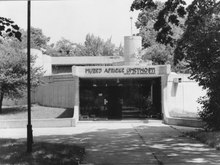
The Museum of African Art in Belgrade is the merely 1 of this kind in the Balkan region. Information technology was opened in 1977 because of Yugoslavia's relations with many African countries thanks to its key role in the Not-Aligned Motility. The museum was opened out of the desire to acquaint the people of Yugoslavia with the art and culture of Africa since there was a deeply rooted notion about Yugoslavia sharing a friendship with African countries thank you to their similar struggles. It was created thank you to Zdravko Pečar and Veda Zagorac who donated to the metropolis of Belgrade their private collection of African art which they nerveless over several decades which they spent on the continent - Pečar was a foreign correspondent and an administrator to several African countries. Over the years, the collection was expanded thanks to the museum buying pieces, receiving them as gifts from Yugoslavs who lived in Africa and as diplomatic gifts which were given the museum by the ambassadors of African countries. As a result, the museum today has a significant collection of fine art and ethnographic items from the Bambara, Dogon, Mossi, Kisi, Dan, Senufo, Ashanti and other people.[14] [15]
National Museum of World Cultures in kingdom of the netherlands [edit]
Jointly administered by the Nationaal Museum van Wereldculturen, public ethnographic museums in the netherlands hold important collections of African heritage. In January 2021, the Dutch government approved a primal mechanism for the repatriation of colonial heritage, and a research grouping is working on applied guidance for colonial collections in Dutch museums.[16]
African art in ethnological collections [edit]
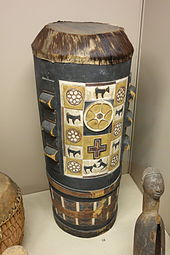
A Kongo drum in the ethnographic collection of the Royal Museum for Central Africa.
Initially, all African art objects were viewed every bit ethnological specimens. Notably, during the period of 1890 through 1913, all large museums redefined their public image in terms of an educational prerogative.[1] In response to the debate around the use of the terms curio and marvel, the League of the Empire in 1904 recommended the "orderly arrangement and the transformation of mere curios into objects of scientific involvement past appropriate classification."[i] [17] Likewise, as a means of validating the expansion of ethnological collections, the rhetoric often employed was ane of the necessity of conservation and preservation in the face of the inevitable extinction of the producers of the materials culture in their custody (121).

Stewart Culin, curator at the Brooklyn Museum, was the get-go American curator to display ethnological collections every bit art objects, not as ethnological specimens, which he did in 1923. Culin distinguished his installation from those of contemporaneous ethnological collections at institutions such as the American Museum of Natural History and the Smithsonian Museum of Natural History in saying that "the objects of Negro art which are displayed publicly form office of museum collections of African ethnology and receive no special attention at the easily of ethnologists... In the bulk of these collections their artistic significance is obscured by the wealth of material, and lost, not infrequently, in the efforts made for its elucidation."[18] [19] Art/Artifact, an exhibition organized past Susan Vogel in 1988, presented 160 objects of art and ethnology selected from the Buffalo Museum of Science, the Hampton University Museum (Virginia), and the American Museum of Natural History (New York City). All three are anthropology museums founded in the 1860s with distinguished African collections. The exhibition examined the shifting definitions of art and artifact, and dealt with the question of how we look at objects from traditional African cultures whose classification systems differ from contemporary Western culture.
African art and Western Modernism [edit]
During the early 1900s, the aesthetics of traditional African sculpture became a powerful influence among European artists who formed an avant-garde in the development of modern art, known every bit the "Primitivism" motion.[5] In French republic, Henri Matisse, Pablo Picasso, and their School of Paris friends blended the highly stylized treatment of the human figure in African sculptures with painting styles derived from the post-Impressionist works of Cézanne and Gauguin. The resulting pictorial flatness, vivid color palette, and fragmented Cubist shapes helped to define early on modernism. While these artists knew cipher of the original meaning and function of the West and Central African sculptures they encountered, they claimed to instantly recognize the spiritual aspect of the limerick and to adapt these qualities to their own efforts to motility across the naturalism that had divers Western art since the Renaissance.[five]
German Expressionist painters such as Ernst Ludwig Kirchner of Die Brücke (The Bridge) group, based in Dresden and Berlin, conflated African aesthetics with the emotional intensity of anomalous color tones and figural distortion, to depict the anxieties of modern life, while Paul Klee of the Blaue Reiter (Blueish Rider) in Munich developed transcendent symbolic imagery.[5] The Expressionists' interest in not-Western art intensified after a 1910 Gauguin exhibition in Dresden, while modernist movements in Italy, England, and the United States initially engaged with African art through contacts with Schoolhouse of Paris artists. These avant-garde artists, their dealers, and leading critics of the era were among the first Europeans to collect African sculptures for their aesthetic value.
American collections [edit]
The 1913 Armory Show marked a seminal moment for America'south advanced. An exposition of about 1,300 works, it introduced the New York fine art audience to movements like Cubism, Fauvism and Futurism, too as the work of European artists including Pablo Picasso, Henri Matisse and Marcel Duchamp. The Arsenal Show and its promotion of Modernism also helped create a sense of taste and a market place for African art in New York.[v]
Notably, in 1914 2 New York galleries introduced African sculpture to their audiences: Robert J. Coady'southward newly opened Washington Square Gallery and Alfred Stieglitz's well-established Lilliputian Galleries of the Photo-Secession. Stieglitz's held an exhibition in 1914 dedicated entirely to African artifacts as works of art.[20]
New York Metropolis progressively positioned itself every bit a key marketplace for African art.[5] During the years 1915-nineteen, American dealers began promoting African objects equally art to a growing grouping of collectors. Among the dealers, Mexican artist Marius de Zayas (1880–1961) was largely responsible for helping some adventurous modern-art collectors, including Walter and Louise Arensberg, John Quinn, and Agnes and Eugene Meyer, to build their African art collections. During the early 1920s, several American institutions began opening their doors to African art.[20]
Brooklyn Museum [edit]

A mask of the We people at the Brooklyn Museum.
In 1903, Stewart Culin (1858–1929) became the founding curator of the Department of Ethnology at the Museum of the Brooklyn Establish of Arts and Sciences, now the Brooklyn Museum.[19] Culin, a self-taught ethnologist, built the foundation of four curatorial collections for the Museum, acquiring objects representing African, Asian, Native American, and Eastern European cultures. Culin was among the first curators to recognize museum installation as an art grade. He was likewise amongst the first to display ethnological collections as art objects, not equally ethnographic specimens. This approach is evidenced in his exhibition "Primitive Negro Art, Chiefly from the Belgian Congo". The exhibition opened in April 1923, and displayed African objects he had acquired in Europe from dealers.
Barnes Foundation [edit]
Albert Barnes was one of the first American collectors to selectively acquire an all-encompassing drove of African sculpture purely on artful merits. In 1923, ii years before the Barnes Foundation opening in Merion, Pennsylvania, Barnes wrote, "When the foundation opens, negro art volition have a place amidst the cracking manifestations of all times."[21] Through his active promotion of the foundation's drove of African sculpture and its aesthetic importance, Barnes himself played a disquisitional office in fostering appreciation of African art in the U.s.a. in the early twentieth century.[6]
Museum of Primitive Art and the Metropolitan Museum of Fine art [edit]

Terracotta seated figure from Mali; 13th century; earthenware; 29.9 cm (eleven 3⁄4 in) high; Metropolitan Museum of Art (New York Urban center). The raised marks and indentations on the back of this hunched Djenné effigy may represent affliction or, more than likely, sacrification patterns. The facial expression and pose could depict an individual in mouring or in pain
Founded in 1954 past Nelson A. Rockefeller and Rene d'Harnoncourt, the Museum of Archaic Art was the first art museum exclusively devoted to exhibiting and collecting works of fine art from Africa, Oceania, and the Americas for their aesthetic value rather than as ethnographic documents or colonial trophies.[22] The museum airtight in 1974, and its collection, staff and library were transferred to the Metropolitan Museum of Art according to an agreement fabricated betwixt Rockefeller and the Met in 1969. The Museum of Primitive Art was in many ways an outgrowth of the Museum of Modern Art (MoMA).[22] It was located directly backside MoMA and was too built on Rockefeller-endemic property. Rockefeller was MoMA's president and d'Harnoncourt was its manager. MoMA's 1935 landmark exhibition African Negro Art was influential in shaping the director of the Museum of Primitive Art.[22] Today, the Museum of Primitive Art drove is housed in the Metropolitan Michael C. Rockefeller Fly.
National Museum of African Art [edit]
The National Museum of African Art in Washington D.C. was founded past Warren Yard. Robbins in 1964 as a private and relatively small collection. In 1979 the collection, by so nigh eight,000 objects, was taken over past the Smithsonian Institution and is at present housed in a central if surreptitious location on the National Mall.
Problems of display [edit]
Many scholars and curators have debated the efficacy of different modes of display of African art in Western museums. More often than not, scholars agree that the Western art museum was, and continues to be, incompatible with the contexts from which most traditional African arts emerged. The following quotation from Kathleen Bickford Berzock and Christa Clarke's introduction to their book Representing Africa in American Art Museum summarizes the reasons for this incompatibility:
"Art museums reinforced hierarchies of value based on media or genre, favoring paintings and sculpture created solely for creative appreciation. In contrast, the visual arts of Africa encompass non only sculpture in wood and metal merely also beadwork, textiles, basketry, and other works of various media, all of which may concur equal value for their creators. And while aesthetics may guide the production of art in Africa, ofttimes there are other social, religious, or political concerns that inform its pattern and utilise. With this range of forms and materials and the unlike circumstances of cosmos and use within society, the various arts of Africa were non suited to the aesthetic hierarchies and systems of classification established past art museums. Moreover, museum practices of collecting and display emphasized the creative person as private genius, the school of artists working in a similar style and vein, and chronology. Such categorization was not easily replicated with African objects, which were ofttimes collected with fragmentary documentation that rarely identified the individual artist or the specific fourth dimension period of creation."[six]
Pan-African activists such every bit Mwazulu Diyabanza and the Front Multi Culturel Anti-Spoliation (Multicultural Front Confronting Pillaging) accept taken direct activity against European museums, taking items from the collections which they say to vest to Africa.[23] [24]
Mail service-1980s African art [edit]
Mail service-1980s curatorial approaches to collecting and displaying historical African art tend towards greater specialization, broadening definitions, and a want for contextualization.[6]
Curatorial contend surrounds questions well-nigh where boundaries should be drawn between traditional and modern, betwixt African and the African diaspora in the Americas and Europe, and between sub-Saharan and North African art. In certain instances, tradition-based and contemporary works have been exhibited together, a practice that began with the exhibition "Astonishment and Power: Kingo Minkisi & the Art of Renee Stout" at the National Museum of African Art in Washington, D.C.[25] However, this exhibition was criticized for suggesting a cultural continuity betwixt pre-modern African art and African-American art today while ignoring crucial cultural differences between these two bodies of piece of work.[26] The Benin artist Meschac Gaba's 2013 installation "Museum of Gimmicky African Art" at Tate Mod responded to the fact that there was to date no museum of gimmicky African art.[27] In September, 2017, the Zeitz Museum of Contemporary Art Africa opened in Cape Boondocks, Southward Africa.[28]
Notes [edit]
- 1. ^ In 1903, the League of the Empire was founded in England with the aim of bringing children from different parts of the Empire into contact with ane another through correspondence, lectures and exchanges. A distinguished group of museum directors and officials headed a sub-commission of the League entitled 'School Museum Committee.'
References [edit]
- ^ a b Coombes, Annie E. (1997). Reinventing Africa : museums, textile culture and popular imagination in tardily Victorian and Edwardian England (2nd pr ed.). New Haven: Yale University Press. ISBN0300068905.
- ^ Owolabi, Tife (February 20, 2022). "Nigeria's looted Benin bronzes returned, more than than a century subsequently". world wide web.reuters.com . Retrieved February 20, 2022.
- ^ Meier, Prita (2010). "Actuality and ITS Modernist Discontents: The Colonial Run into and African and Middle Eastern Art History". The Arab Studies Journal. 18 (1): 12–45. ISSN 1083-4753. JSTOR 27934077.
- ^ a b Enid Schildkrout and Curtis A. Keim, ed. (1998). The Scramble for Art in Key Africa. Cambridge: Cambridge University Press.
- ^ a b c d e f g Denise, Murrell (Apr 2008). "African Influences in Modernistic Art". Heilbrunn Timeline of Art History. New York: The Metropolitan Museum of Fine art.
- ^ a b c d e Berzock, Kathleen Bickford; Christa Clark (2011). Representing Africa in American Fine art Museums. Seattle & London: University of Washington Press. pp. iii–19.
- ^ "History: From Congo Museum to RMCA". Royal Museum for Primal Africa. Archived from the original on iii November 2013. Retrieved viii October 2013.
- ^ Girshick Ben-Amos, Paula (1995). The Fine art of Republic of benin. Smithsonian. ISBN1560986107.
- ^ von Luschan, Feliz (1919). Die Altertümer von Benin. Berlin.
- ^ Jean Paul Crespelle, The Fauves, tr. Anita Brookner, Greenwich, Connecticut: New York Graphic Society, 1962, p. 114.
- ^ Françoise Gilot and Carlton Lake, Life with Picasso, 1964, repr. New York: Ballast/Doubleday, 1989, ISBN 978-0-385-26186-ix, p. 266.
- ^ Co-ordinate to Christopher Green, Picasso: Architecture and Vertigo, New Oasis, Connecticut: Yale University, 2005, ISBN 978-0-300-10412-vii, p. 51 this is "by and large accustomed" although denied past Picasso himself.
- ^ Arthur I. Miller, Einstein, Picasso: Space, Fourth dimension and the Dazzler that Causes Havoc, New York: Bones, 2001, ISBN 978-0-465-01859-8, p. 92: [A]lthough the sharp change in the correct-hand demoiselles occurred later on Picasso's visit to Trocadéro, . . . . [i]t turns out that African art supported his conceptual arroyo and convinced him of the deep meaning of geometry equally the language of the new art."
- ^ Sladojević, Ana; Emilija, Epštajn (eds.) (2017). Nyimpa kor ndzidzi: (Re)conceptualisation of the Museum of African Art. Belgrade: Museum of African Fine art. ISBN978-86-85249-21-i.
- ^ "Near the Museum". Museum of African Art . Retrieved 23 Feb 2021.
- ^ Hickley, Catherine (2020-10-08). "Kingdom of the netherlands: Museums confront the country's colonial by". UNESCO. Archived from the original on 2020-11-01. Retrieved 2021-04-19 .
- ^ Museums Periodical. iv: 101. September 1904.
{{cite journal}}: CS1 maint: untitled periodical (link) - ^ Culin, Stewart (1923). "Negro fine art". Brooklyn Museum Quarterly. x (iii): 120.
- ^ a b Siegmann, William C.; Dumouchelle, Kevin D. (contributions) (2009). African fine art a century at the Brooklyn Museum. Brooklyn, NY: Brooklyn Museum. ISBN9780872731639.
- ^ a b "Special Exhibition Tells Story of How African Artifacts Were First Recognized as Art in U.South." Printing Room. The Metropolitan Museum of Fine art. Retrieved viii Oct 2013.
- ^ Albert C. Barnes to Paul Guillaume, Nov five, 1923, the Barnes Foundation Archives, Merion, Pennsylvania.
- ^ a b c Ezra, Kate (2010). Kathleen Bickford Berzock, Christa Clarke (ed.). Representing Africa in American art museums : a century of collecting and display. Seattle: University of Washington Printing. ISBN9780295989617.
- ^ Feiger, Leah (22 September 2020). "Colonizers Stole Africa's Art; This Human being Is Taking It Back". Vice . Retrieved 8 February 2021.
- ^ Haynes, Suyin (14 October 2020). "A French Court Fined Activists for Attempted Theft of a Museum Artifact. They Say It Belongs to Africans". Fourth dimension . Retrieved eight Feb 2021.
- ^ Atwood, Roger (17 September 2012). "African Art: Beyond the Masks". ARTnews . Retrieved xvi October 2013.
- ^ Cotter, The netherlands (xviii July 1993). "ART VIEW; Fine art That's Valued for What It Can Practise". The New York Times . Retrieved 16 October 2013.
- ^ "Museum of Contemporary African Fine art". Archived from the original on 2013-03-07. Retrieved 2013-10-17 .
- ^ Almino, Elisa Wouk (2017-09-22). "A closer look at Africa's first gimmicky fine art museum". Hyperallergic. Archived from the original on 2017-09-22. Retrieved 2021-04-25 .
External links [edit]
- Art of Oceania, Africa, and the Americas from the Museum of Archaic Art: an exhibition at the Metropolitan Museum of Art, an exhibition catalog from The Metropolitan Museum of Art Libraries (fully available online as PDF)
Source: https://en.wikipedia.org/wiki/African_art_in_Western_collections
0 Response to "What Resources Was Used a Lot of African Art"
Postar um comentário