What Is the Main Job of the House of Representatives
- Introduction
- What is the Legislative Co-operative?
- What does the House of Representatives practice?
- Additional Resource
- Means to Become Involved/What You Can Do
- Suggestions for Your Next Conversation
Introduction
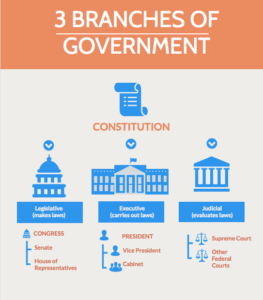 The United states of america spent eight long years of desperate fighting for independence from 1775 to 1783. By 1789, the Founding Fathers had set about constructing a government "congenital on the cardinal confidence of revolutionary-era republicanism: that no fundamental authority empowered to coerce or discipline the citizenry was permissible , since it merely duplicated the monarchical and aristocratic principles that the American Revolution had been fought to escape. The United States is now the oldest indelible republic in globe history, with a set of political institutions and traditions that have stood the examination of time."
According to House.gov , "To ensure a separation of powers, the U.S. Federal Regime is made up of three branches: legislative, executive and judicial. To ensure the regime is effective and citizens' rights are protected, each branch has its own powers and responsibilities, including working with the other branches." This is often referred to every bit " checks and balances ," and prevents whatsoever one role of government from wielding too much political ability.
Why information technology Matters
 America benefits from a judicial branch positioned to halt executive branch overreach. The President of the United States cannot stay in power indefinitely and is unable to force the U.Due south. Congress to laissez passer laws. From the very outset, and yet to today, the American people have access to and influence over their elected representatives.
The House of Representatives most directly reflects the desires of the American public due to the ratio of American citizens to U.Southward. Representatives and the constant election cycle every two years. Much of the deadlock of the U.S. government that nosotros witness today reflects a divided American people.
This brief focuses on the Legislative branch of the U.S. authorities, in detail the House of Representatives, including the nuts and bolts of how its inner workings, and how everyday citizens can influence the legislative process. For a brief on the U.S. Senate, click here .
Salvage Save
What is the Legislative Co-operative?
The legislative branch is made upward of the Business firm of Representatives and the Senate , known collectively as the Congress. Among other powers, the legislative co-operative "makes all laws, declares war, regulates interstate and foreign commerce and controls taxing and spending policies."
CrashCourse U.South. Regime and Politics, produced in collaboration with PBS, explains the Bicameral Congress (nine min):
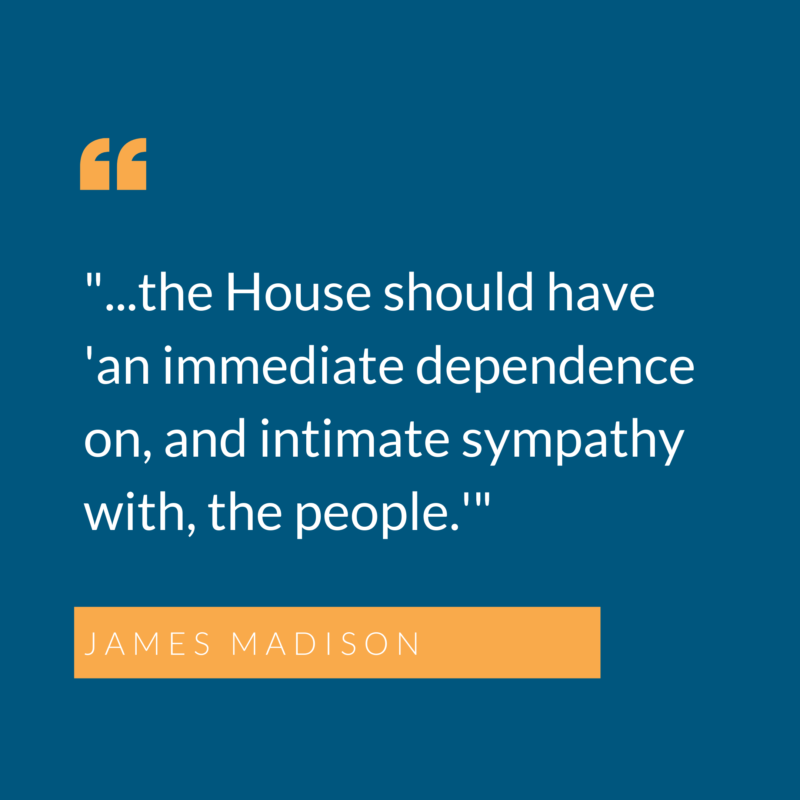
Of all federal authorities institutions, the House of Representatives is designed to be closest to American voters, nearly closely reflecting the private cares and concerns of American taxpayers. In fact, the House is the but institution that has been straight elected past American voters since its formation in 1789.
"'If proportional representation takes place, the modest States contend that their liberties will be in danger. If an equality of votes is to be put in its identify, the large States say their money will be in danger,'" explained Benjamin Franklin . What eventually "emerged from weeks of stalemate was chosen the 'Great Compromise' and created a bicameral legislature with a House, where membership was determined by state population, and a Senate, where each state had two seats regardless of population."
Size and Structure of the House
There are 435 representatives in the House , and have been since the number was fixed by law in 1911. Each House representative is elected to a two-twelvemonth term serving the people of a specific congressional district in a state. "Each land receives representation in the House in proportion to the size of its population but is entitled to at least ane representative." This means that states with large populations have more than representatives than small states take. Representation based on population was "i of the most important components of the Federal Ramble Convention of 1787," as ane of the founders' greatest concerns was designing a system of government that would better correspond the public than did the British model from which they had won independence.
In add-on to the 435 representatives from the states, in that location is a Resident Commissioner from Puerto Rico and Delegates from Washington D.C., American Samoa, Guam, The Democracy of the Northern Mariana Islands, and the Virgin Islands. The Resident Commissioner and Delegates are able to serve and vote on committees, just practise not accept the same full voting rights as the 435 state representatives.
The Role of the Census
Specifically, seats in the House " are apportioned based on land population according to the constitutionally mandated Demography." The Demography, which occurs every ten years and is overseen past the Bureau of the Census, role of the U.Due south. Department of Commerce. Tying representation to Demography information allows the number of each state's representatives to increase or decrease forth with fluctuations in state population. The Census information is then used to make up one's mind congressional districts, areas in the state from which representatives are elected to the Firm. This process is called redistricting. For more than on redistricting and the Census, see The Policy Circle'southward Decennial Demography Cursory.
 Elections
Members of the House of Representatives " must stand for ballot every two years , after which information technology convenes for a new session and essentially reconstitutes itself – electing a Speaker, swearing-in the Members-elect, and approving a slate of officers to administer the institution." Biennial elections are held in November, and the Congress commences in the following January. To be elected, a representative must be at least 25 years old, a United States citizen for at to the lowest degree vii years, and a resident of the country he or she represents. U.S. House candidates are not required to live in the congressional commune they correspond.
The Life of a Representative
According to Congressional Management Foundation'south Life in Congress written report , when representatives are in Washington, D.C., they study spending their time equally follows:
- 35% on "Legislative/Policy Work"
- 17% on "Constituent Services Work"
- 17% on "Political/Campaign Work"
- ix% on "Printing/Media Relations"
- 9% on "Family/Friends"
- 7% on "Authoritative/Managerial Piece of work"
- half dozen% on "Personal Fourth dimension"
When in their home commune, they reported spending time as follows:
- 32% on "Elective Services Work"
- 18% on "Political/Campaign Piece of work"
- fourteen% on "Press/Media Relations"
- 12% on "Legislative/Policy Work"
- ix% with "Family/Friends"
- viii% on "Personal Fourth dimension"
- seven% on "Administrative/Managerial Work"
Compensation
Article I, Section six of the Constitution requires Congress to determine its own pay. Congress's " current automatic adjustment formula , which is based on changes in private sector wages," was established past the Ideals Reform Act of 1989. The last pay aligning was in January 2009. Since, well-nigh representatives earn $174,000 annually, while the majority and minority leaders make $193,400. The Speaker earns the largest bacon at $223,500. Additionally, representatives "are field of study to some specific laws and regulations regarding the acceptance of gifts ," particularly gifts from registered lobbyists or from private entities that retain or employ a lobbyist.
What does the Firm of Representatives practice?
Responsibilities of the House
Per the Constitution , the Business firm and Senate together make and pass federal laws, introduce bills and resolutions, offering amendments, and serve on committees that enable members to develop specialized knowledge on the matters under that committee's jurisdiction. Though both make upwardly Congress, there are a few distinctions between the 2. In detail, the Constitution "provides that just the Firm of Representatives may originate revenue bills, " and by tradition information technology also originates cribbing bills.
Additionally, while the Constitution does not specifically mention investigations and oversight , "the authorisation to comport investigations is implied since Congress possesses 'all legislative powers'." The House initiates impeachment proceedings and passes articles of impeachment (the Senate sits as a court to try the impeachment).
Finally, during a presidential election, the House of Representatives steps in if no candidate receives a bulk of the total electoral votes. Each state delegation has 1 vote to cull the President from amongst the top 3 candidates with the largest number of balloter votes.
Leadership in the House
Subsequently each election, the political political party that wins the most representatives is designated the " Majority ." The other party is the " Minority. " The majority party holds cardinal leadership positions, such as Speaker of the House. The same party can have the majority in both the House of Representatives and the Senate, or the chambers tin be separate. Third parties rarely take enough members to elect their own leadership, and so independents generally bring together i of the larger party organizations to receive committee assignments.
The Business firm is run by majority dominion. When a majority of members vote to do something in the House, it gets done. Majority rule makes passing legislation relatively efficient, and that means that the political party in the minority has less power to set up the calendar or pass its proposals. This contrasts with the Senate, where a unmarried senator – in the bulk or the minority – can more often than not force a vote or stop a nib in its tracks.
Firm Leadership includes the Speaker of the Business firm, Majority and Minority Leaders, and Majority and Minority Whips.
The Speaker of the Firm is the presiding officeholder of the Firm, and is elected by the members of the House. The Speaker administers the Oath of Role to Firm members, chairs certain committees or nominates committee chairs (namely the chairs of the House Administration Committee and the Rules Commission ), and appoints members of various committees and Firm staff. After the Vice President, the Speaker is second in line to succeed the Vice President.
Majority and Minority Leaders represent their respective parties on the House floor. Each is elected past his or her respective political party. The majority leader is second to the Speaker and schedules legislative business, planning legislative agendas rather than serving on committees. The minority leader serves as the minority party's spokesperson, substantially the minority party's counterpart to the Speaker. He or she as well chairs the minority party's committee assignment panel.
Bulk and Minority Whips serve equally middlemen to between their party leaders and members. They "maintain advice betwixt the leadership of the party and its members, align back up for party positions on the floor, count votes on central legislation, and persuade wavering Members to vote for the party position."
The Speaker of the House is elected past the entire House of Representatives, while the Republican Conference and Democratic Caucus elect the other leadership positions. The Republican Conference is the formal organization of Republican Members in the House, and the Democratic Caucus is that of the Democratic Members.
Run into electric current Business firm Leadership positions here.
The Role of Committees
Committees " are permanent panels governed by House chamber rules, with responsibility to consider bills and issues and to take general oversight relating to their areas of jurisdiction." Committees have dissimilar legislative jurisdictions, but each considers, shapes, and passes laws related to its jurisdiction, and monitors agencies, programs, and activities within their jurisdiction. Each committee has a chair that leads the total committee, and a ranking fellow member who leads the minority members of the committee. Committee assignment directly affects a representative'due south work in Congress. After a Congressional ballot, political parties assign newly elected representatives to continuing committees
Crash Form U.S. Regime & Politics explains what Congressional committees do (viii min):
Some of the almost well-known committees include:
- The Business firm Commission on Ways and Means , which oversees all taxation, tariffs, and other revenue-raising measures.
- The Firm Commission on Appropriations , which has jurisdiction over setting specific authorities expenditures.
- The House Committee on Foreign Affairs , which has jurisdiction over foreign assist and oversees national security developments affecting foreign policy.
- The House Commission on the Judiciary, which oversees the judiciary and civil and criminal proceedings.
Most committees are regular standing committees, which continue from ane Congress to the next. There are also select committees, special committees formed for a brusk period of time for a specific purpose such every bit an investigation, and there are several joint committees with the Senate. See a total list of all Firm Committees here .
Legislation in the Business firm
Legislation begins with an thought . Information technology may come from a Congressman, a staffer, a elective, or a idea leader or expert on a given subject. You lot may recollect the School Firm Rock video , which walks through the legislative process in an attainable way and is bully to share with your kids (3 min):
Drafting Legislation
Working with Business firm parliamentarians — lawyers and clerks who provide nonpartisan guidance on rules and procedures — and other Congressional staff on Capitol Loma, the Congressional representative'due south staff drafts the bill. The parliamentarians have specific expertise; they piece of work closely with staff in a non-partisan manner to typhoon the specific language of the bill. Staff works to build sponsors and cosponsors earlier the nib is introduced.
Introducing a Nib
Whatsoever Fellow member, Consul, or Resident Commissioner tin can introduce a bill when the house is in session by " placing it in the 'hopper, '" a box on the House Clerk's desk in the Capitol building. The Member who introduces the bill is known every bit the main sponsor. The nib is then formally assigned a number past the Clerk. A bill originating in the House will showtime with "H.R." (for the House of Representatives, every bit opposed to "S." for the Senate). The Speaker's office then assigns that bill to its committee(s) of jurisdiction, which then assigns the pecker to a subcommittee(s).
Committee Process
The Subcommittee seeks input from relevant departments and agencies and holds public hearings. After hearings, there is a markup on the legislation , in which "views of both sides are studied in particular and at the determination of deliberation a vote is taken to determine" whether or not the subcommittee recommends the bill to the full committee. In the full committee, the subcommittee reports on the bill; this coming together provides an opportunity for Members to amend the legislation. In that location is as well the possibility that the committee tables the beak or fails to accept action , which prevents the bill from reaching the total House. You can watch Business firm Commission hearing videos here .
To get to the total House, the committee staff writes a study describing the purpose of the bill, why the neb is recommended, and an analysis of each part of the bill and how the nib may affect existing constabulary. A full committee mark-up and the decision of what legislation makes information technology to the House floor is tightly controlled past the Committee Chairman's office and leadership. When the legislation is reported favorably out of the total committee it awaits a decision by leadership to schedule time for information technology to be debated on the Firm floor. This decision is a negotiation based on priorities of the committee and of leadership.
Subsequently a committee has reported a bill, the beak is placed on the calendar . This means the bill is eligible for flooring consideration, but not that information technology will necessarily go far to the floor. In the House, it is upwardly to the majority party leadership to determine which bills the Firm will consider on the floor, and in what social club.
Committee on Rules
Once leadership has decided that a specific slice of legislation will receive floortime, the House Majority Leader alerts the committee of jurisdiction that the bill will be considered on the House Floor, and this kicks off the Rules Commission procedure.
The Committee on Rules , or Rules Committee, is one of the oldest standing committees in the House. The Committee is normally known as "The Speaker'due south Committee" – prior to 1910, the Speaker chaired the Rules Committee, and today it is the mechanism by which the Speaker maintains control of the House Floor. The Rules Commission is sometimes likewise referred to every bit " the traffic cop of the Business firm ," as information technology determines how much time will be immune for debate on each piece of legislation considered on the Firm floor, and if any (and which) amendments will be allowed to be considered during the argue.
Most bills are considered under a procedure known as break of the rules , "which limits debate to 40 minutes and does not allow amendments to exist offered by members on the flooring." Otherwise, the bill is considered under terms tailored for the particular neb. In this example, the House adopts a resolution called a special rule from the Rules Committee. After the Rules Committee reports the dominion for considering the bill and the Firm votes to adopt the dominion, the Business firm can and so go along to the floor debate.
Floor Contend
In one case the rule has been adopted, the House unremarkably considers the bill "in a procedural setting called the Committee of the Whole , which is essentially "the House assembled in a different grade; it is a commission of the House equanimous of every Representative that meets in the Business firm chamber." This procedure "allows members an efficient way to consider and vote on amendments."
Subsequently the flooring debate on amendments and the underlying legislation, the Committee of the Whole reports to the full House, which so votes on the bill. The beak passes the House by a simple majority , 218 votes of the 435 total. It then goes to the Senate and waits to exist scheduled for flooring time.
Meet The Policy Circle'south Senate Cursory to see how the process continues.
Boosted Resources
Glossary of terms
Different types of legislation
Alternative legislative procedures in the House
Ways to Get Involved/What You Can Do
Measure & Identify : Who are the influencers in your country, county, or community? Acquire about their priorities and consider how to contact them
- Practise you know who your Congressional Representative is ? What almost your land elected officials ?
- Rail your representatives' votes with GovTrack .
Reach out: You lot are a catalyst. Finding a common cause is a great opportunity to develop relationships with people who may be outside of your immediate network. All information technology takes is a small-scale team of two or three people to gear up a path for real improvement. The Policy Circle is your platform to convene with experts you lot desire to hear from.
- Find allies in your customs or in nearby towns and elsewhere in the state.
- Foster collaborative relationships with colleagues, neighbors, friends, and local organizations to mobilize an attempt to bring attention to your issue to your local Congressional office. Also reach out to community leaders to educate them and request their date on the issue.
Plan: Set up some milestones based on your state's legislative agenda .
- You can detect the legislative agenda for the House of Representatives here .
- Don't hesitate to contact The Policy Circle squad, communications@thepolicycircle.org , for connections to the broader network, advice, insights on how to build rapport with policy makers and constitute yourself as a civic leader.
Execute: Give it your best shot. You lot can:
- Research: Make certain you know the facts virtually the result y'all are raising. Government agencies, think tanks, and media outlets can all be good resources. Remember to research all sides of the issue to make sure you understand various angles. You can likewise talk with people who are afflicted by the issue with which you are concerned; anecdotal information combined with measured data can be powerful.
- Write: Although we may be more inclined to email in the digital age, writing an old-fashioned letter to your local elected representatives or to members of Congress is still one of the most effective ways to influence lawmakers.
-
-
- See these tips for step-by-step instructions to write letters to elected officials, including how to address your representative, reference specific legislation, and properly ship your correspondence.
-
- Organize: Organize people to telephone call in, follow-up on written cloth, and reach out to other community members to brainwash them on the issue. Demonstrating wide support can be very effective in influencing a legislator to back up your position.
Working with others, you may create something smashing for your community. Here are some tools to learn how to contact your representatives and write an op-ed .
Source: https://www.thepolicycircle.org/brief/makes-u-s-exceptional-u-s-house-representatives-explained/
0 Response to "What Is the Main Job of the House of Representatives"
Postar um comentário